Headline photo

Headline photo
Rockcliffe and Kippford from South Glen Brae: Ed Iglehart [CC-BY-SA-2.0 (www.creativecommons.org/licenses/by-sa/2.0)], via Wikimedia Commons

Introductory text

Kippford and Rockcliffe are on the East Stewartry Coast, an unspoilt National Scenic Area with two other NSAs in close proximity. It is in Dumfries & Galloway, South West Scotland, a region known for it's wonderful scenery, biodiversity, turbulent history, smugglers and black and white 'belted' cattle known as Galloway Belties. This stretch of coastline has many names. Known locally as the Colvend Coast or the 'Secret Coast' (due to the peace and tranquility) it is often referred to as the 'Scottish Riviera' due to it being the holiday resort of choice for Victorian millionaires and having a Gulf Stream influenced microclimate: evidenced by palm trees in some gardens. Castle Douglas, the food town is a short drive away and Kirkcudbright, the Artists Town is over the next headland.


This a scenic and unique part of the world and we started the blog to share the experience of living in this wonderful place. We hope that it will be of interest to others who live here and give those planning to visit the area a taste of all it has to offer.


The blog has a correspondent in both Kippford and Rockcliffe village, you can also follow their Twitter feeds on the right of the page. If you would like to get involved we look forward to hearing from you.

Tuesday, 20 May 2014

Could we soon see Pine Martens back along the Colvend Coast?

A new report has shown pine martens are starting to re-colonise the south of Scotland after being absent from most of the area for nearly 200 years

Pine Marten
I love seeing Pine Martens on visits to the Highlands of Scotland so we were very excited to see this recent BBC News report last week:
Link to the BBC report here: http://www.bbc.co.uk/news/uk-scotland-south-scotland-27308955
"The Scottish Natural Heritage (SNH) study, with The Vincent Wildlife Trust (VWT), found them in three areas. The new sites are south and west of Glasgow, the Upper Tweed Valley and Annandale and Eskdalemuir.
VWT survey coordinator Lizzie Croose described the discovery of the rare animals as "significant".
Pine martens were once found throughout the UK, but suffered a dramatic decline in the 19th century due to woodland clearance, trapping for fur, and predator control by gamekeepers.
In the last half of the 20th century, however, populations recovered in Scotland and are now established in most areas north of the Central Belt, including the northern fringes of Glasgow and some other parts of the Central Belt.
The species is still rare in the UK and absent from most of England and Wales.
In 1988, the species was given full legal protection.
Now it has been discovered at the three new sites in southern Scotland after a lengthy absence.
A small number of pine martens were re-introduced to the Galloway Forest in the early 1980s, but the new arrivals are not thought to have spread from this group - which has remained in isolation. These new groups of pine martens have most likely originated from "a combination of natural spread and deliberate releases".
The great news is that:
Rob Raynor, SNH's mammal advisory officer, said that it was "quite likely" they would re-colonise most suitable habitats in southern Scotland in time.
"At present, re-colonisation of the new areas is still at an early stage, but if breeding populations do establish successfully, pine martens will probably expand throughout southern Scotland and south into northern England," he said.
These sites are not that far away from the Colvend Coast so I hope they will re-colonise this area too. Along at Sandyhills is a hill called Wildcat Hill, so it could be assumed that the Scottish Wildcat one roamed this area too.

It would be fantastic to have them here too.


Tuesday, 1 April 2014

A Charming Little Tower House - Orchardton Tower

I often find myself drawn to this little mid 15th Century circular tower house which is quite unique in Scotland. There is something special about it and its surroundings.


Its location is just off the A711 located 4 miles south of Dalbeattie, and 1 mile south of Palnackie, in Buittle parish Grid reference - NX 817 551
 
 
Entrance to Main Body of Tower
 
 
Built by John Cairns,1456.The main body of the tower is 17ft in diameter and originally the main floor had two further floors above. It stands around 33ft high.


Standing Approx 33ft High


Historic Scotland Information Board

The Towers Neighbours
 
.
 . 
 
For more detailed information visit 


Wednesday, 12 February 2014

D&G ONE OF THE MOST ROMANTIC PLACES IN BRITAIN


ROYAL MAIL AWARD D&G AND CUMBRIA AS MOST ROMANTIC PLACES IN BRITAIN .

According to Royal Mail Facts and Figures D&G is one of the most romantic places in the country, due to the fact we send and receive more valentines cards than anyone else ! 

Royal mail calculated last year on the 13th of February they handled 32% more First class mail on the day before valentines in D&G and Cumbria than they would on a normal day !

So not only is D&G the marriage capital with the Gretna Green Famous Blacksmiths Shop with bookings 20% up on last year for weddings in 2014. But we also have Rabbie Burns Romantic poems and Wonderful Romantic Countryside and Coastlines . So if your wanting to treat your Beloved this year on Valentines day , or any day of the year D&G is the place to be for Romance and Valentines weekend!


Many thanks to @DGWGO for Tweeting this.

Tuesday, 28 January 2014

Colvend - A model community

I recently found this wonderful archive on the Internet. There is lots of historic information on the area, this is a link to it:
Internet Archive - Texts

Below is an excerpt from 

Transactions and journal of the proceedings of the Dumfriesshire and Galloway Natural History and Antiquarian Society

from the 1892 - 93 session, it makes for fascinating reading. Here is a link to it if you want to read more: Transactions and Journals of the Proceedings of the Dumfrieshire and Galloway Natural History and Antiquarian Society


Below I have included a section on the Parish of Colvend which included Kippford and Rockcliffe. 

Nowadays the name Colvend is generally held to refer to a village and not the Parish. (Although it is still the Parish of Colvend). The village we know as Colvend was originally the village of Loch End as it clustered around the Southern end of White Loch. You can still see the building that used to be the Smithty, a single story, simple barn like building that stands gable on to the road (A710). It is now used as a garage for the appropriately named Forge Cottage.

It gives a wonderful insight into the history of the area and suggests that the Parish of Colvend should be a model for other Parishes and Districts. Happy reading!

Colvend differs from the majority of parishes, which, as a 
rule, are divided, and belong to a few individuals. In many 
cases a single individual owns the whole. In Colvend it is 
different. At the beginning of the time with which my paper is
concerned, the parish was divided into eighteen or nineteen 
properties, owned by as many proprietors or heritors. One of 
these properties, the Barony of Barcloy, was held in trust by the 
Kirk Session of Caerlaverock, for the poor of Caerlaverock, and 
for the higher education of the children of Caerlaverock. This 
gave rise to the witticism, "The poor of Caerlaverock are the 
lairds of Couen." Of the eighteen or nineteen properties into 
which the parish is divided, two of the larger — Fairgirth and 
Auchenskeooli have changed hands, and to the former Meikle- 
cloak has been added, to the latter Glensone and Ryes. Glen- 
stocken, the property of Mr Carrick Moore, near relative of Sir 
John Moore, the hero of Corunna, was purchased by the late 
Mark Sprot Stewart of Southwick, and is now owned by his son. 
Sir Mark J. Stewart, Bart. Kipp was acquired by purchase 
from the Crosbie family, by Mr Chalmers, the present proprietor. 
Auchenhill and Orchardknowes are owned by Lord Young, and 
Clonyard by Mr M'Call. In other respects properties in the 
parish, considered I'elatively to the number of owners, and to 
the size of the properties, continue unchanged. The number of 
landed proprietors is still nearly the .same. 

The estates and properties vary much in size and value. In 
one or two instances the rental touches or did touch, a few years 
ago, £2000. In others it ranges between £200 and £800, and 
in some instances it comes down to £50, £30, and even less. 
To me this gradation in ownership has always seemed pleasing, 
and in many respects desirable, and in this respect I have often 
considei'ed Colvend unique. I know no other parish similarly 
circumstanced as to ownership. Inseparably, indeed, connected 
with the ownership of the land are the tenantry or tenant farmers 
of a parish The tenant farmers of Colvend, like the proj)rietors, 
rent and occupy farms of varying size, and of rents varying 
according to the size and value of their holdings. Some of the 
farms in the parish are wholly agricultural, but many have 
attached to them portions of moorland or hill pasture, and in 
one or two instances the hill and moorland pasture constitutes 
the more valuable portion of the farm. The rents vary from 
£100 to £200 and £300, and in one instance runs up to £600, 
but this inchides two farms, one of which is known as what is 
called a led farm. The others graduate down to £50 or £40. 
These latter are tenanted in many cases by those who in their 
early life were farm servants, or day labourers, who have been  
industrious and saving, and were able to begin farming in a 
small way, and on their own account. From these latter not 
unfrequently spring the men who rent the largest and best 
cultivated farms in the district. This also is a feature character- 
istic of Colvel^d, and which I should gladly see extended to other 
parishes and districts. 


Tuesday, 20 August 2013

Kippford: it's history as shipbuilding village


It's been a busy Summer here on the Colvend Coast with record temperatures in July. I guess I must apologise for blog post's being thin on the ground but I hope you will forgive us. There is so much to do around here that we haven't had a spare moment to post. What we do have is lots of material written, in the wings so to speak, and we will be posting it at intervals over the coming weeks.


For all those who haven't managed to visit us in person this Summer here is a virtual visit you can make from the keyboard of your computer. A little web tour through the maritime history of this fascinating coast.

Following Kippford Week sailing Regatta (you can go to the Solway Yacht Club website here for results: The Solway Yacht Club website. It's a handy site to bookmark as they have the weather forecast for Kippford and Rockcliffe on the home page) my thoughts turned to the sailing history of this stretch of coast and so I did a bit of research.

A fascinating resource on the history of the area is the Dalbeattie Museum Trust (www.dalbeattiemuseum.co.uk) so it seemed like a good place to start. The Dalbeattie Museum is run entirely by volunteers on charitable donations and is well worth a visit. It is loved by children and adults alike. You can find it at 81, High Street, Dalbeattie and it provides an amazing glimpse into life along the Solway Coast in days gone by.

Their website has a page on Harbours and Quays from Solway Firth to Dalbeattie and it makes for interesting reading. To quote from their web page:

Rockcliffe
This area was first known as "Red Bay", until 1964. Originaly a very quiet place until some houses were built, then it became a holiday resort for people out of Glasgow. There was never a jetty or quay here, as the beach was to rocky to land any vessels.
Rockcliffe courtesy of Dalbeattie Museum website.
 
http://www.dalbeattiemuseum.co.uk/stories/harbours-and-quays-from-solway-firth-to-dalbeattie/

Kippford
Kippford was a place that many ships were built in the Cummings yard. He employed 8 shipwrights and 4 apprentices. The apprentices were housed in the cottages along the front at Kippford. On a launch day the children from Barnbarroch School were given the day off. All the ship building in Kippford was done out in the open air. In the early days the ships were built side-on to the river beside Whim Cottage, later they were built on the slipway. A steam box used to steam the planks of wood for fitting to the bows and stern of a vessel, was located next to the road beside the village water pump. Next to this pump could also be found a saw-pit where planks were cut, there was also a tar kettle. The workers in the yards religiously upheld the daily visit to the hotel as soon as the sun got over the yard arm. They each had an allowance of whiskey twice a day There was also a stone jetty which was used to load and unload cargoes for the Quarry at Kippford. This is now used by the Yacht Club at Kippford. 
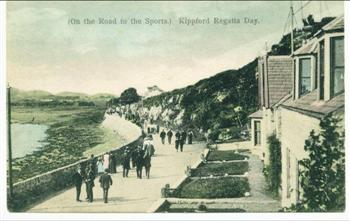
The vessels were loaded with chippings for Lancashire and as late as World War 2 the Caledonian Granite Company was shipping granite out of this area. Prior to 1887 the Dalbeattie road ended beside the Mariner Hotel. A large rock blocked the road to Kippford. People had to walk along the beach or up over the hill if the tide was in. 1881 was when this rock was blasted to make a through road. Mr Cumming sail loft was used as a dance hall, usually after a ships launch. Mrs Agnes Houston of Brownrigg, Dumfries, was a lady who liked to organise events for the crews of schooners lying at the port. She also organised sculling and rowing races for sailors in 1885 and presented prizes of tobacco, knives and money. This led to the Kippford Regatta we have today in Kippford, held every year. After Mr Cumming death the yard was taken over by Mr Collins from Birkenhead, who ran it for several years till the outbreak of the war in 1914. No ships were built in Mr Collins time but in his time of owning the yard, he was to install a motor engine into local schooner called the North Barrule, during the summer of 1909.

Regatta Day Kippford
Regatta day at Kippford courtesy of Dalbeattie Museum website. http://www.dalbeattiemuseum.co.uk/stories/harbours-and-quays-from-solway-firth-to-dalbeattie/

The webpage starts it's journey at Caulkerbush (Southwick) and describes each port along the coast along to Palnackie. To read the full text go to: http://www.dalbeattiemuseum.co.uk/stories/harbours-and-quays-from-solway-firth-to-dalbeattie/

Another excellent source of information on the maritime history of the area is to be found on the Dalbeattie Town website (www.dalbeattie.com).  They have a page on the history of Kippford which you can access in full here: http://www.dalbeattie.com/history/kipphist.htm

Their section on ship building at Kippford reads:

There had been boat repair at Kippford for a long time, but in the early 1800s there was construction of small sloops on the shore. By 1860, this was successful enough for Mr. James Cumming to take over some gardens and a section of the beach and to construct a ship, - the Try Again - over some seven years. She was followed by the construction of the Balcary Lass in 1881; the Balcary Lass was lost in 1883 on a voyage from Goole to St. John's, Newfoundland, whilst carrying coals; it is possible that the coal caught fire, as the ship was in good order.

Because of the steep and narrow beach, ships to be repaired were floated sideways onto the beach and then winched onto blocks. This launching system meant that re-launching was also sideways, a difficult procedure that once nearly damaged a newly-repaired schooner. The Cummings then laid down a proper slipway, with a cradle onto which ships could be drawn. Once in place, a capstan winch ashore could draw cradle and ship up the well-greased slipway for repairs, then assist in the careful re-launching.


The slipway was finally disposed of about 1914, as the level of shipping declined. James and his brother John Cumming died, the lease was taken over by Mr. Collins of Birkenhead, but the business dwindled to small boat repair and ended in the 1920s.


There are still many prints of the old ships of the Urr in the 'Anchor Hotel', which was actually the shipbuilders' pub. They received a dram of whiskey twice a day as well as three shillings (36 old pence or 15p.), per day in wages. This was at a time when ordinary labourers received barely half that sum. The publican used to cover the benches in newspaper, as the shipbuilders' clothes were well-tarred from their work.

There is still a small recessed slip, but this is not on the line of the slipway, which was slightly farther to the north. However, the Kippford Slipway Ltd., though largely a boat-chandlers, does keep up some of the old tradition.


My final port of call is the wonderful website Old Kirkcudbright - Glimpses into the history of an ancient Parish and Burgh. You can access it here: www.old-kirkcudbright.net

This site is a marvel and is described as "An Internet Browse Through the History Topography and Genealogy of the Ancient Parish and Burgh of Kirkcudbright" - The material is taken from a selection of contemporary books, magazines, documents, maps, illustrations and ephemera. I love to just dip in and browse, I always find something new to intrigue me about the area. The section on Kippford is a mine of information, and far too long to include here, but I recommend you follow this link: www.old-kirkcudbright.net/pages/scaur1.asp

I love this opening quote "I have visited many villages in England, Ireland, Scotland and Wales, but never have I come across one that could satisfy my longings in every respect, as does the Scaur with its more modern name of Kippford. True it is a place of moods and tenses. When the Estuary of the Urr is in full tide, on whose banks the village stands, and the golden sun is shining on its waters the visitor may think it a perfect paradise." 

The site describes the history and industry of the village as well as the Urr Water Fleet and has some excellent yarns of long distance voyages, shipwrecks and fine old skippers...and there are some evocative old photographs... it's well worth a visit!

Kippford: Sailing vessel crossing the road on the slipway
(Source: www.old-kirkcudbright.net - The Stewartry Museum Collection)

Enjoy your virtual visit to the maritime history of this beautiful coastline...

Tuesday, 21 May 2013

Looking forward to Spring Fling 2013 - our final round up of last years event.

Not long now until Spring Fling our local open studios event - 25th to 27th May 2013


We never get the chance to visit all the artists during the open studios event so last year we sent out our roving reporter Lynn Watt who happily accepted the challenge and opportunity for a great day out . Thank you for sharing your day Lynn.


"One of the many charms of Spring Fling is tootling around pretty countryside lanes and coming across all sorts of lovely venues & varying styles.  Within a couple of miles of the Carsethorne coast we came across:


Ailsa Black
Wee red boat
Wee Red Boat
Along at Kirkbean Village Hall, with teas on offer, we found a huge selection of original paintings, varying sizes of prints, and cards. Ailsa’s distinctive style makes use of a strong but limited palette with powerful pops of colour, often phone- or letter-box red (quite literally!) beautifully offset by blue seas & skies. Taking inspiration from Scottish fishing-village life, albeit one where a seal and seabird confer – or a sheepdog & bird head out on the ‘Randan’  – Ailsa uses repeat motifs  with beautiful design and gentle humour  to fabulous effect.  Wonderful stuff!  
Ailsa Black's Art at Kirkbean Village Hall
 
Val Macadam
starry kippford night      wee daisies
Starry Kippford Night and Wee Daisies
White geese transforming into white sheets on a washing line, the black & white markings of a cow called Daisy merging with daisies in the field! Val’s eye for soft colours, pattern and quirky humour work brilliantly with her skilled detailing.  And never more so than in her delightful village- & town-scapes, capturing local scenes in infinite detail or much-loved homes and gardens for personal commissions. We can see where Val gets much of her inspiration -  her lovely cottage, which she turns into a gallery for the Fling, has fabulous views of the Solway, is surrounded by fields and her gorgeous cats, who often feature in her  ‘Wee prints’ and cards, were posing to order!  
Sadly Val is not opening her studio this May but you can view her work at www.valmacart.com  www.facebook.com/valmacadamart
Val Macadam's Studio Entrance
 
Lettie Blackett

Lettie’s studio is a relaxed, easy-going space; ancient, rough stone walls with glimpses of garden beyond, decorated with fabulous flowers. And paintings & mixed media!  We loved the Indian paintings which capture the tremendous colour and speed of Indian street life, but with a magnetic stillness around the central figures. Lettie hopes to return to India soon to gather more inspiration – already looking forward to seeing the results next year."
www.lettieblackett.com/   


You can find out all about this years Spring Fling at http://spring-fling.co.uk/
With 93 visual artists, makers and designers participating in this great event.

Submitted by Lynn Watt busy Editor and manager of  luxury BirchLea Holiday Lodge  Kippford.
Art work shown  with the kind permission of Ailsa and Val. All art work and photos are copywrited.
 

Thursday, 9 May 2013

Threave Castle Home of Archibald the Grim and Ospreys.

 
I have always enjoyed the short walk down to Threave Castle . As a child, I always ended up running there with great  excitement at the opportunity of ringing the custodians bell to call the ferryman before my sister.
 
I just loved the little boat ride over the river Dee.
 In those days it was a rowing boat now its a much quicker journey with an outboard motor so sea sickness tablets are not necessary.
 
Crossing the River Dee to Threave Island and Castle
 
Now its more of a wander down the path and an opportunity to learn more about the fascinating history of the area and spot wildlife. I spotted two deer on this walk.
 
This trip was prompted by hearing the news that two Osprey a male and female had returned to the nest near the castle so I waited in the hide in anticipation There are five hides along the river and marshes and there is often a RSPB volunteer on hand who can give you lots of information. This time I was unlucky but have had reports from our guests who have seen them. I have been trying to find out if there are any eggs yet but have not heard.
 
If you are interested in Ospreys you can keep up to date by following the National Trusts Blog for Threave Estate.


.
The hard working NTS Staff have really made a difference on the Estate managing 1500 acres, laying paths, planting trees, encouraging wildlife and  building hides. Earlier this year work was carried out to ensure the Osprey platform was secure and safe.
 
 Threave Estate was designated as Scotland's first Bat Reserve in 2010 with seven species recorded. There are two Bat trails  around Threave Gardens and Kelton Mains. Bat detectors are available to hire from Threave Gardens visitor centre
  
To learn more about Threave Estate and Gardens

Crossing The River Dee
 
/
A thousand years ago Threave Island was said to be the home of the ancient rulers of Galloway. The tall, forbidding tower that now dominates the island was built for Sir Archibald Douglas in 1369 and is all that remains.
 
Sir Archibald had recently become Lord of Galloway, but is better known as Archibald ‘the Grim’. His Father had been King Robert the Bruce's friend during the Wars of Independence against England. Archibald continued that fight. The English gave him the name The Grim due to his frightening appearance in battle.
  In 1400 he died at Threave and was by then the 3rd Earl of Black Douglas, the most powerful magnate in Southern Scotland.

When James II tried to overthrow the over-mighty Black Douglases about half a century later, after a two-month-long siege at Threave, the island stronghold reverted to the Crown.
Threave Tower
I am always delighted to see Dumfries and Galloway in the National Press and receive recognition for being such a wonderful area and here is an article on a walk around the Estate published in The Guardian.
 
http://www.guardian.co.uk/travel/2012/
 may/13/castle-douglas-and-threave-Galloway-walk
 
 
Threave Island was also recently listed in UK'S Tiny Islands Top Ten Hidden Gems 
 
 
The Island is managed by Historic Scotland for details of opening times please visit their website
 .

 
© All images and video subject to copyright - not to be reused, copied or altered without written permission